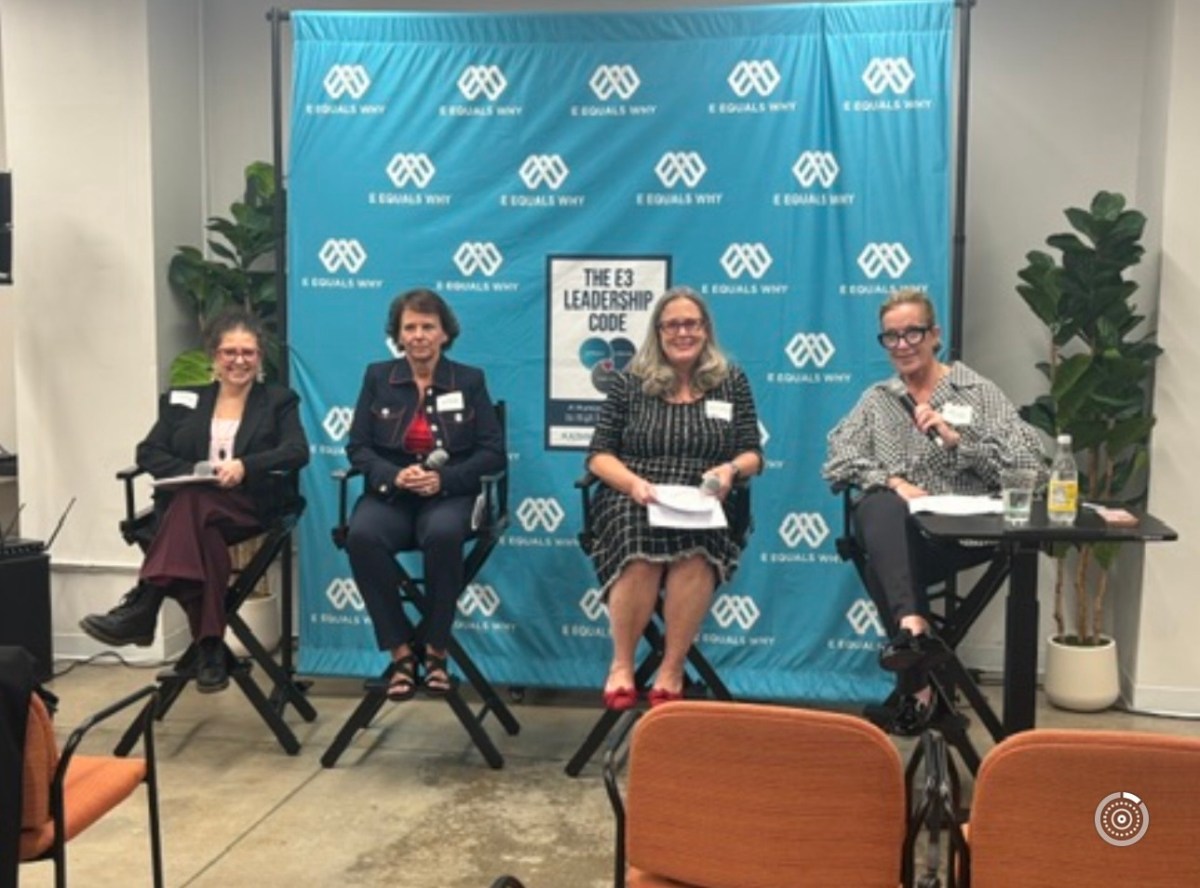
Last night, I had the honor of once again stepping up to the microphone to emcee a leadership event sponsored by my sister’s company, E Equals Why, and Shift/Co, led by the brilliant mastermind Terri Maxwell.
We were also joined by creative coach Tracy Loring, who guided us through a powerful exercise on intuition and how we can use it to become better leaders, employees, and, quite frankly, human beings.
The room was buzzing.
Leaders. Authors. Entrepreneurs. Thinkers. Doers. People who came together not simply to listen but to participate, learn, and perhaps walk away with a slightly different perspective on what it means to lead.
And there I was. Microphone in hand. Right in my element.
For those of you who know Kiki, give me a microphone and an audience, and I’m happier than a squirrel who just discovered an espresso machine.
But I digress.
The evening centered around something called The Human Advantage.
Two words that have never been more important.
We are living in a world where artificial intelligence is advancing faster than I can finish my morning Venti Iced Americano. Technology is changing how we communicate, work, learn, and make decisions.
And while I’m fascinated by it all, I can’t help but wonder if we’re losing something precious along the way.
Our humanity.
Perhaps it was always slipping through our fingers, but lately the absence of genuine human connection feels almost palpable.
Here’s the thing.
I spent twenty-one years in the corporate world, where I earned my business chops. I’ve worked for some extraordinary people and a few who could have benefited from a leadership seminar. Or twelve.
I’ve also had the privilege of leading teams in executive roles. I’ve been on both sides of the desk. The person making decisions and the person waiting for someone else to make them.
These days, I’m an employee in the educational world. I’m part of a team rather than the person leading it.
Different chair. Different responsibilities. Same human being.
And here’s what I’ve come to realize.
Whether you’re leading the team or sitting on the team, our fundamental needs are remarkably similar.
We want to matter. We want to contribute. We want to be appreciated. We want to be seen. Heard.
Remember Maslow’s Hierarchy of Needs? I certainly do. Years of college coursework drilled that pyramid into my brain. The theory, in its simplest form, suggests that human beings have fundamental needs that influence their ability to grow and reach their potential.
I’m not about to turn this blog into Psychology 101. Nobody needs a pop quiz before breakfast. But Maslow was onto something.
And recently, I found myself sitting smack in the middle of my own little psychological experiment. After nearly fifteen years working in my school district, I received my very first performance appraisal. Fifteen years.
I’m happy to report that I received the highest rating across the board. Now, before anyone thinks I’m polishing a trophy for the mantel, let me explain something. I’m probably one of the most modest people you’ll ever meet. Confidence has never been my strongest suit. I can emcee a room full of strangers without blinking, yet accepting a compliment about myself can send me into an emotional game of dodgeball.
My boss, an Assistant Superintendent, sat across from me and explained how happy he was to work with me. He told me that he never had to worry about anything in the world of registration because he knew I had everything under control.
I smiled.
I thanked him.
And then he noticed something.
“You seem quiet.”
Oh boy.
Kiki was quiet.
Anyone who knows me understands that this is generally the calm before some sort of verbal weather event.
I hadn’t planned to say anything.
In fact, my brain was screaming, Just smile. Sign the paper. Get back to work.
But apparently my mouth had other plans.
“I’m invisible.”
There it was. Two words that had been sitting quietly inside me for years. I continued.
“For fifteen years, I’ve come to work every day and treated this place like my home. Because in many ways, it is. I love what I do. I care about the families. I care about the district. I take enormous pride in my work.”
I paused.
“And this is the first time anyone has actually sat down and told me how happy they are with my performance.”
His face dropped. Not because he had done anything intentionally wrong. But because I think, at that moment, he realized something.
Sometimes the people who require the least attention are the people who receive none.
I explained that I’m not needy. I don’t require constant praise, applause, or a marching band parading through the Registration Office every time I successfully enroll a student.
Although, let’s be honest, a little confetti now and then wouldn’t hurt. I simply wanted to be acknowledged.
I was a person. With a voice and feelings.
I signed my evaluation and went back to work.
The following day, the apologies began.
I appreciated them, but I gently held up my hand.
“Please don’t apologize. Just remember that I am me. I’m not the other members of this team. This is my voice. Someone else may have completely different needs, feelings, or expectations.”
And there it was.
The Human Advantage.
I didn’t have a fancy name for it when I sat in that office. I wasn’t referencing a leadership book, a psychological theory, or a corporate training module.
I was simply being human.
Fast-forward to last night.
There I was, sitting beside three extraordinary women, guiding conversations about leadership, intuition, communication, and the importance of understanding the people around us.
And that conversation in my boss’s office kept replaying in my head.
I listened to these brilliant women share their knowledge. I watched the audience lean in, nod, reflect, and participate.
And I kept coming back to one thought.
You cannot truly lead people until you make an effort to know them.
Not their job descriptions.
Not their productivity reports.
Not the numbers they generate or the boxes they check.
Them.
The person who arrives early because she takes pride in her work.
The employee who rarely complains but quietly carries more than anyone realizes.
The colleague who seems distracted because life outside the office is weighing heavily on their shoulders.
The team member who has a brilliant idea but is afraid to speak because nobody has ever asked for their opinion.
Every single person walks into a workplace carrying an entire life that doesn’t appear on an organizational chart.
And sometimes the greatest leadership skill isn’t having all the answers. It’s knowing when to stop talking and start listening.
We spend so much time teaching people how to manage, motivate, delegate, and produce results.
But how much time do we spend teaching them how to see one another?
Artificial intelligence can analyze performance. It can generate reports, identify trends, and make recommendations in seconds.
But genuine empathy? The ability to recognize that someone is struggling behind a perfectly polished smile?
The intuition to sense that the quietest person in the room might have the most important thing to say?
That’s where we humans still have something extraordinary to offer. We shouldn’t be so quick to surrender it.
I rode home on the train last night thinking about how funny life can be. One moment I’m sitting in an office wishing someone would hear my voice. The next, I’m holding a microphone, helping an entire room explore why listening to that voice matters.
Talk about coming full circle.
Maybe leadership isn’t about being the loudest person in the room, having the biggest title, or occupying the fanciest corner office.
Maybe it’s about making sure nobody in that room feels invisible. Because at the end of the day, we don’t need another algorithm to tell us how to treat one another.
We need to look up from our screens, make eye contact, ask a question, and actually listen to the answer.
And if you happen to be a leader reading this, here’s a little assignment from Kiki.
Tomorrow, find the person who quietly makes your world run a little smoother.
Look them in the eye.
Tell them you see them.
Tell them they matter.
And for heaven’s sake, don’t wait fifteen years to do it.


Great post. AI is a challenge, and it is critical to learn to deal with it while also staying human and able to relate to people. These are critical management skills. If we leverage machines so much that we forget there are still humans who use and manage them, then it is game over.
LikeLiked by 1 person
It is so true. We also discussed the generational factor. Most people there last night were in our age group. The younger set will mainly know AI. Where and when does the discussion start with them?
LikeLiked by 1 person
And thank you for commenting!
LikeLike